Invoice basics · 7 min read
Invoice vs receipt vs purchase order: which document to send
Five documents show up in an ordinary sale, and clients routinely ask for the wrong one. Each proves something different, and sending the wrong document is a common reason payments stall.
"Can you send me an invoice for that?" is sometimes a request for an invoice, and sometimes a request for a receipt, a proforma, or a statement. Getting the document right on the first attempt saves a round trip and, with larger clients, avoids losing a payment run cycle entirely.
Worked example
Worked example: a corporate client order
Every document in that chain references the one before it. That chain is what makes an account easy to audit and easy to chase.
- 14 August
- the client's procurement team issues purchase order PO-88214 for 30 hours of consultancy at 120 per hour.
- 15 August – 5 September
- work is delivered. No document changes hands.
- 8 September
- you issue invoice NS-2026-151 for 3,600, quoting PO-88214 prominently near the top, with a stated due date and payment reference.
- 22 September
- payment arrives. You send a short receipt confirming 3,600 received by bank transfer on 22 September against invoice NS-2026-151.
- 30 September
- you send a month-end statement showing the invoice, the payment, and a zero closing balance.
Original diagram
Invoice vs receipt vs purchase order: which document to send decision flow
- 1The five documents, in order
- 2Where "bill" fits in
- 3Documents that get confused most often
- 4A practical rule
The five documents, in order
The simplest way to keep these straight is to place them on the timeline of a single sale.
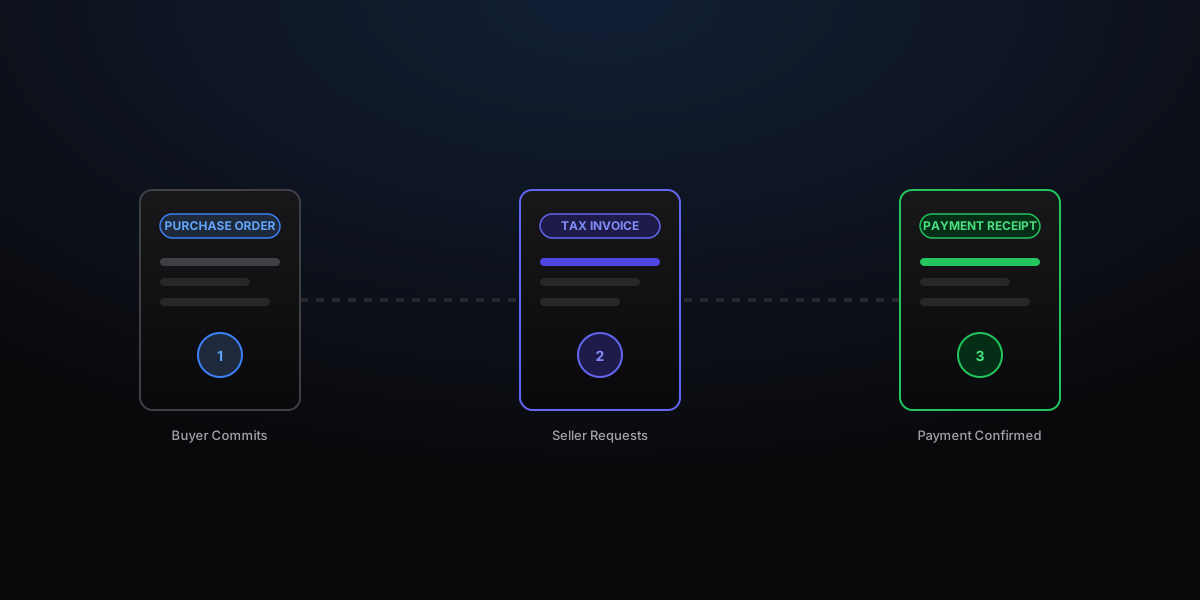
1. Purchase order — the buyer commits:
Created by the buyer, before anything is delivered. It states what they are ordering, at what price, in what quantity, and often on what terms. It is the buyer's authorisation to spend, and once you accept it, it usually forms part of the agreement between you.
The important consequence for a seller: if a client issues purchase orders, your invoice must quote the PO number. Without it, their accounts payable system has nothing to match your invoice against, and the invoice will sit unpaid regardless of how clearly your payment terms are written.
2. Delivery note — the goods arrive:
Accompanies a physical shipment and lists what is in the box. It usually shows quantities but no prices. Its job is to let the receiving party confirm they got what was ordered, and it becomes the evidence in any later dispute about a short delivery.
3. Invoice — the seller requests payment:
Created by the seller, after the agreed billing trigger. It states the amount owed, the due date, how to pay, and what reference to use. It creates a receivable in your accounts and a payable in the client's.
4. Receipt — the payment is confirmed:
Created by the seller, after money has been received. It proves payment happened. The distinction matters: an invoice proves you asked, a receipt proves they paid. Clients need receipts for expense claims, warranty support and their own bookkeeping.
5. Statement of account — the period is summarised:
A periodic summary of everything on a client's account: invoices raised, credits applied, payments received, closing balance. It is a reconciliation tool, not a payment demand. Sending a statement instead of an invoice is a common and costly mistake, because most accounts payable systems will not pay against one.
Where "bill" fits in
Bill and invoice describe the same document from opposite ends. You issue an invoice; your client receives it and records it as a bill to pay. Accounting software often reflects this directly, using "invoices" for money coming in and "bills" for money going out.
There is a soft distinction in everyday language: a bill tends to imply immediate payment, as in a restaurant or a utility, while an invoice implies terms and a future due date. It is not a distinction worth arguing about with a client. If they ask for a bill, send your invoice.
Documents that get confused most often
Invoice vs proforma invoice:
A proforma looks like an invoice but is issued before the billing trigger and does not create a receivable. It is used for deposits, internal approvals, and customs. If you have been sending real invoices so clients can raise purchase orders, you should be sending proformas instead.
Invoice vs quote:
A quote is an offer the client can accept or decline. An invoice is a request for payment on work already triggered. Sending an invoice when the client expected a quote reads as presumptuous and often damages the relationship more than the billing error itself.
Receipt vs paid invoice:
Marking an invoice PAID, with the date and method received, generally works as a receipt for business clients. Consumers and expense-claim processes sometimes require a distinct receipt document. When in doubt, sending a short standalone receipt costs nothing.
A practical rule
Before you send anything, ask what the recipient needs to do with it. Approve a spend? Purchase order. Release a payment? Invoice with a PO reference. Claim an expense? Receipt. Reconcile a quarter? Statement. Decide whether to hire you? Quote. The document follows from the action, not the other way round.
Common questions
Helpful clarifications
Is a bill the same thing as an invoice?
They are usually the same document viewed from different sides. The seller sends an invoice; the buyer receives it and calls it a bill. In everyday use, bill also tends to describe amounts due immediately, such as a restaurant bill, while invoice implies credit terms and a future due date. If a client asks for a bill, send your standard invoice.
Can an invoice also serve as a receipt?
Only if it is clearly marked as paid, with the payment date, the amount received and the method. An invoice on its own proves an amount was requested, not that it was paid. Many businesses issue a separate receipt or simply stamp the invoice PAID with the date, which is generally sufficient for a client who needs proof of payment for their own records.
Who creates a purchase order, the buyer or the seller?
The buyer. A purchase order is the buyer's formal instruction to buy specified goods or services at an agreed price. The seller then delivers against it and invoices referencing the PO number. If a client sends you a purchase order, quoting its number on your invoice is usually the single most effective thing you can do to get paid on time.
What is a statement of account?
A statement summarises all activity on a client account over a period: invoices issued, credits applied, payments received, and the closing balance. It is not a request for payment on its own and should never be used in place of an invoice. Statements are most useful for clients with several open invoices who need a single view of what is outstanding.
Do I need to issue a receipt if the client already has the invoice?
Not always, but it is good practice and some clients require one. Consumers in particular often need a receipt for warranty claims or expense reimbursement. Business clients may be satisfied with a bank record plus the original invoice. Requirements differ by country and by sector, so confirm what applies to your business.