Client billing · 7 min read
PO numbers and three-way matching: getting paid by larger clients
When a big company pays you late, it is usually not a decision. It is an invoice sitting in an exception queue because one field did not match. Understanding how accounts payable works removes most of those delays.
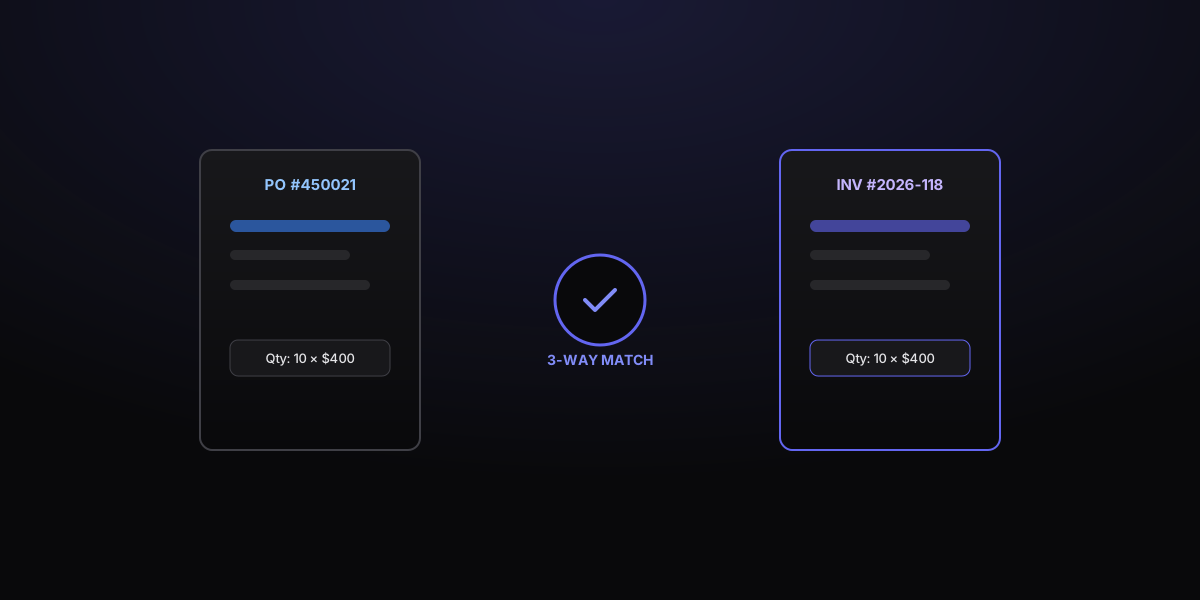
Small businesses pay invoices by reading them. Large businesses pay invoices by matching them. That difference explains why the same invoice that gets paid in three days by a ten-person studio can sit for seven weeks at a corporate client, with polite responses and no money moving.
Worked example
Worked example: an invoice that would have stalled
A contractor is engaged by a manufacturer for a two-phase project. PO 4500219883 is raised with two lines: "Phase 1 — site assessment, 1 ea, 4,000" and "Phase 2 — implementation support, 1 ea, 11,000."
- Point 1
- The invoice that stalls: a single line reading "Professional services — September" for 15,000, addressed to the parent group, with the PO number in the email subject only.
- Point 2
- The invoice that clears: addressed to the contracting entity's registered name; PO 4500219883 in a labelled field at the top; two lines matching the PO's wording and values exactly; a note confirming Phase 1 was accepted on 12 September; sent to the AP mailbox with the PO number in the filename.
- Point 3
- Same work, same total. One goes into a payment run; the other goes into a queue.
Original diagram
PO numbers and three-way matching: getting paid by larger clients decision flow
- 1How accounts payable actually processes your invoice
- 2The fields that cause rejections
- 3What to do before the work starts
- 4When an invoice is held anyway
How accounts payable actually processes your invoice
At any organisation above a certain size, your invoice is not read by a person first. It is scanned or ingested, its fields are extracted, and the system attempts to match it to an approved commitment. Only if the match fails does a human get involved — and that human is working through a queue that includes everybody else's failed matches too.
The match is usually a three-way match:
If all three agree within tolerance, the invoice is approved for the next payment run without anyone touching it. If they disagree by even a small amount, the invoice is held.
Some organisations use a two-way match for services, comparing the PO and the invoice only. The practical implication for you is the same: the PO is the anchor.
- The purchase order — what the buyer authorised, at what price and quantity
- The receipt — a goods receipt note or a service confirmation, recording what actually arrived or was accepted
- The invoice — what you are charging
The fields that cause rejections
Nearly every match failure comes from one of these:
- Missing or wrong PO number. The single most common cause. Typos matter — PO-88214 and PO88214 may not be treated as equivalent.
- Wrong legal entity. Global clients often have dozens of registered entities. Billing "Acme Group" when the PO was raised by "Acme Services Ltd" fails the match.
- Invoice total exceeds the PO balance. Even by a rounding difference.
- Line items that do not correspond. If the PO has three lines and your invoice has one summary line, the system cannot reconcile them.
- No goods receipt. Your work was delivered but nobody on the client side confirmed it in their system. Your invoice is correct and still unpayable.
- Sent to the wrong address. Invoices emailed to your day-to-day contact rather than the AP mailbox often never enter the system at all.
- Unsupported file format. Some portals reject scanned images, password-protected PDFs, or invoices embedded in the body of an email.
What to do before the work starts
Almost all of this is preventable at onboarding. When you take on a client large enough to have an AP function, ask four questions:
That last question is the one most suppliers never ask, and it is often the difference between 14 days and 45. If a client runs payments on the 25th with a 10-day approval window, an invoice sent on the 20th will not be paid until the following month no matter what your terms say.
- Which legal entity am I contracting with, and what is its exact registered name and address?
- Will a purchase order be raised, and when will I receive the number?
- Where do invoices go — an AP email address, a supplier portal, or an e-invoicing network?
- What are the payment run dates, and what is the cut-off for an invoice to be included?
When an invoice is held anyway
Chase the block, not the balance. Asking "can you check where invoice NS-2026-151 against PO 4500219883 is in your process?" gets a useful answer. Asking "when will I be paid?" usually gets a forwarded email.
The two most common blocks have specific fixes:
Keep your day-to-day contact informed but direct process questions at AP. Confusing the two roles slows things down for everyone.
- No goods receipt. Ask your project contact — not AP — to confirm receipt in their system. AP cannot do this for them.
- Price or quantity variance. Ask which line and by how much. Then either credit the difference or request a PO amendment, depending on who is right.
The underlying principle
Your invoice needs to be verifiable by someone who was not involved in the work. A PO number is simply the cleanest way to provide that. Where a client has no PO system, supply the equivalent: a signed quote reference, a contract number, or the name and date of the approval. The easier it is to confirm your invoice is legitimate, the faster it moves.
Common questions
Helpful clarifications
What happens if I forget the PO number on an invoice?
In most accounts payable systems the invoice cannot be matched, so it goes into an exception queue instead of the payment run. Nobody is refusing to pay you; the invoice simply has nowhere to go. Some systems reject it automatically and email you, others hold it silently. Resend a corrected invoice with the PO number rather than asking them to add it manually.
What is three-way matching?
It is a control where the buyer checks three documents against each other before paying: the purchase order (what was ordered), the goods receipt or service confirmation (what was actually received), and your invoice (what is being charged). If quantities and prices agree across all three, payment is released automatically. If any one disagrees, the invoice is held for human review.
Can I invoice for more than the purchase order amount?
Not without the PO being amended first. Invoicing above the PO value will fail the match and stall, even if the extra work was genuinely requested and verbally approved. Ask your contact to raise a PO amendment or a second PO covering the additional scope, then invoice against the updated figure.
Should I send one invoice per purchase order?
Yes, as a default. Combining several POs onto one invoice forces a manual split on the client's side and is a frequent cause of delay. One invoice per PO, with line items in the same order and wording as the PO, is the arrangement most systems handle without intervention.
My client does not use purchase orders. Does any of this matter?
The principle still applies: give the payer a reference that connects your invoice to something they already approved. That might be a signed quote number, a contract reference, a project code, or the name of the person who authorised the work. The goal is that whoever opens your invoice can verify it without having to ask anyone.