
Document Standards · 7 min read
Proforma invoice: what it is and when to send one
A proforma invoice states a committed price before the work is delivered or the goods ship. It looks like an invoice, but it does not ask to be paid in the same way — and confusing the two causes real accounting problems.
No. A proforma invoice is a preliminary document that states what you intend to charge. It is not a demand for payment and is not normally recorded as a sale in your accounts. Only the final invoice creates a receivable and belongs in your sales records. Because rules vary by country, confirm the treatment that applies to your business before relying on a proforma for anything tax-related.
A quote invites a client to consider a price and is often exploratory, with options and ranges. A proforma invoice is firmer: it is formatted like the final invoice, lists exact line items and totals, and is normally issued after the client has indicated they want to proceed. In practice a quote helps a client decide, while a proforma helps them get internal approval or arrange payment.
Yes, and this is a common reason to send one. Many companies need a document with a total and bank details before their finance team can release an advance payment. If a client pays against a proforma, issue the final invoice afterwards and reference the payment already received so both documents reconcile cleanly.
Give it a reference, but keep it outside your main invoice sequence. Using a separate prefix such as PF-2026-014 prevents gaps in your real invoice numbering and makes it obvious which document is provisional. When you issue the final invoice, quote the proforma reference on it so the client can match the two.
Often, yes. Customs authorities and freight forwarders frequently request a proforma invoice before goods move, because it declares the description, quantity, value and origin of what is being shipped. Requirements differ by destination and shipment type, so check with your carrier or a customs broker rather than assuming a generic template will satisfy every route.
Most billing confusion comes from one document doing two jobs. A client asks for "an invoice so I can get this approved," you send a real invoice, and now you have a receivable on your books for work that has not started. Six weeks later the scope changes, and you are issuing a credit note to unwind something that never should have been recorded.
The proforma invoice exists to solve exactly this. It gives the client a formal document with line items, totals and payment details, without creating a sale in your records. Once you understand where it sits in the billing sequence, the rest of your paperwork gets simpler.
Worked example
Worked example: a design project deposit
A studio agrees a brand identity project worth 4,800 in the client's currency, with 40% payable before work starts. The sequence:
- Quote sent 2 September
- three package options, scope assumptions, valid 30 days.
- Step
- Client selects the middle package. Their finance team asks for "an invoice" to process the deposit.
- Step
- Proforma PF-2026-014 issued 5 September for 1,920, labelled clearly, valid until 5 October, with bank details and a note that the balance will be invoiced on delivery.
- Step
- Deposit received 12 September. The studio now issues final invoice NS-2026-088 for the deposit amount, referencing PF-2026-014.
- Step
- Project delivered 30 October. Final invoice NS-2026-112 for the remaining 2,880, with a line showing the deposit already paid.
Original diagram
Proforma invoice: what it is and when to send one decision flow
- 1What a proforma invoice actually is
- 2Proforma invoice vs. quote vs. final invoice
- 3When a proforma invoice is the right document
- 4What to include on a proforma invoice
What a proforma invoice actually is
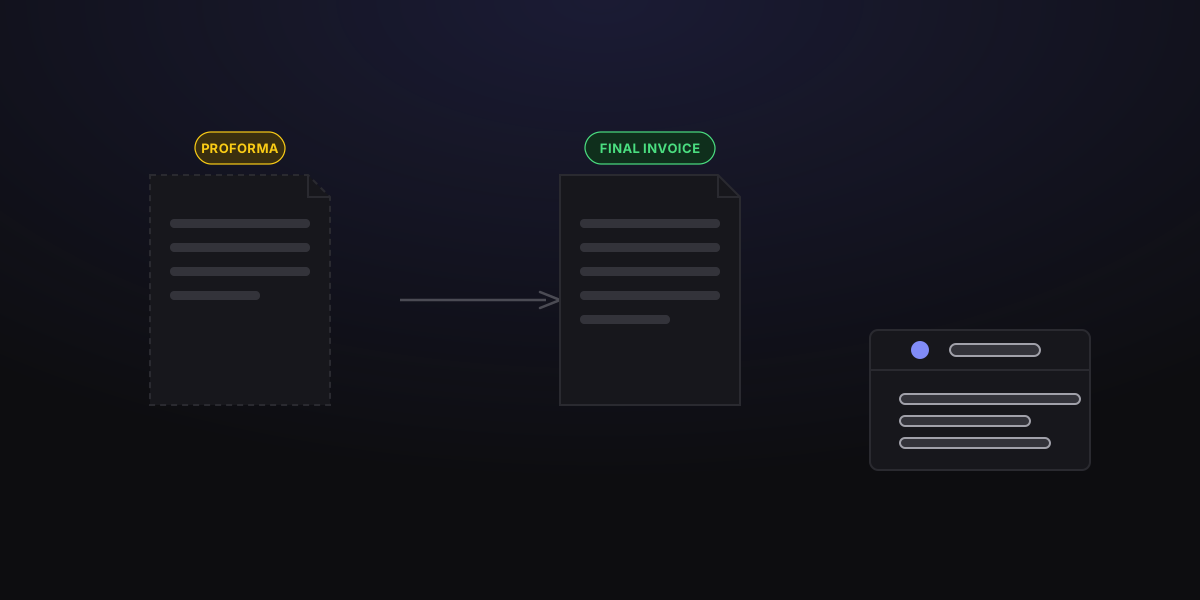
A proforma invoice is a good-faith statement of what you will charge, issued before the billing trigger has occurred. The name comes from the Latin for "as a matter of form" — it has the form of an invoice without the function of one.
Three things follow from that:
Because tax treatment differs between jurisdictions, treat the point above as a general principle and confirm the specifics with an accountant who knows your local rules.
- It is not a demand for payment. It is an expectation of one. A client is not in breach of terms by leaving it unpaid.
- It does not belong in your sales ledger. Revenue is not recognised and tax is not usually accounted for at the proforma stage.
- It is not final. Quantities, dates and totals can still move, which is why the document should say so plainly.
Proforma invoice vs. quote vs. final invoice
These three documents map to three stages of the same conversation.
The quote: helping a client decide:
A quote is persuasive. It can include options, ranges, assumptions, exclusions, and a validity period. Its audience is the person choosing whether to hire you. Clients frequently compare quotes side by side, so context and scope description matter more than precision.
The proforma: helping a client commit:
A proforma is administrative. The decision is largely made; now the client needs a document their finance team, bank, or customs broker will accept. It mirrors the final invoice exactly: same line items, same totals, same bank details, same reference conventions. The only difference is the label and the fact that nothing has been delivered yet.
The final invoice: asking to be paid:
The final invoice is issued once the agreed billing trigger has happened — delivery, milestone completion, or the close of a service period. It carries a sequential invoice number, a stated due date, and it enters your accounts as a receivable.
When a proforma invoice is the right document
Send one when the client needs a formal figure before you have earned the right to be paid. The common situations:
- Advance or deposit payments. Many finance departments cannot release funds without a document showing a total and payment instructions.
- Internal purchase approval. A client's procurement process may require a document that looks like an invoice to raise a purchase order against.
- International shipping and customs. Carriers and customs authorities routinely request a proforma declaring the value, quantity and origin of goods before they move.
- New clients with no payment history. A proforma lets you agree the exact numbers in writing before committing production time.
- Grant, budget or reimbursement claims. The client may need evidence of a committed cost before the spend happens.
What to include on a proforma invoice
Build it from your normal invoice and change four things. Everything else should stay identical, because the whole point is that the client sees no surprises when the real invoice arrives.
Keep the line-item detail, the client's legal name and address, your business details, the subtotal, any tax shown as an estimate, and the total.
- Label it unambiguously. The words "Proforma Invoice" should be the largest text on the document, and the phrase "This is not a tax invoice" should appear near the total.
- Use a separate reference series. Something like PF-2026-014, kept outside your sequential invoice numbering.
- Replace the due date with a validity date. "Valid until 15 October 2026" is honest; "Due 15 October 2026" is not.
- State what would change the figures. One line covering quantity variation, exchange-rate movement, or shipping cost is usually enough.
A simple rule for choosing
Ask what the document is for. If the client is still deciding, send a quote. If the client has decided but nothing has been delivered, send a proforma. If your agreed billing trigger has happened, send an invoice and start the clock on your payment terms.
Common questions
Helpful clarifications
Is a proforma invoice a legal invoice?
No. A proforma invoice is a preliminary document that states what you intend to charge. It is not a demand for payment and is not normally recorded as a sale in your accounts. Only the final invoice creates a receivable and belongs in your sales records. Because rules vary by country, confirm the treatment that applies to your business before relying on a proforma for anything tax-related.
What is the difference between a proforma invoice and a quote?
A quote invites a client to consider a price and is often exploratory, with options and ranges. A proforma invoice is firmer: it is formatted like the final invoice, lists exact line items and totals, and is normally issued after the client has indicated they want to proceed. In practice a quote helps a client decide, while a proforma helps them get internal approval or arrange payment.
Can a client pay a proforma invoice?
Yes, and this is a common reason to send one. Many companies need a document with a total and bank details before their finance team can release an advance payment. If a client pays against a proforma, issue the final invoice afterwards and reference the payment already received so both documents reconcile cleanly.
Does a proforma invoice need an invoice number?
Give it a reference, but keep it outside your main invoice sequence. Using a separate prefix such as PF-2026-014 prevents gaps in your real invoice numbering and makes it obvious which document is provisional. When you issue the final invoice, quote the proforma reference on it so the client can match the two.
Do I need a proforma invoice for international shipping?
Often, yes. Customs authorities and freight forwarders frequently request a proforma invoice before goods move, because it declares the description, quantity, value and origin of what is being shipped. Requirements differ by destination and shipment type, so check with your carrier or a customs broker rather than assuming a generic template will satisfy every route.