
Global Business · 7 min read
Invoicing in another language: bilingual and localised invoices
An invoice your client's finance team cannot read gets set aside for someone who can. Language is not a courtesy on a cross-border invoice — it is part of how fast you are paid.
The person who hired you probably speaks your language. The person who processes the payment often does not, and they are the one whose speed determines when the money arrives. That gap is where most language-related payment delays live.
Worked example
Worked example
A studio in one country bills a manufacturer in another, monthly. Their invoice shows:
- Step
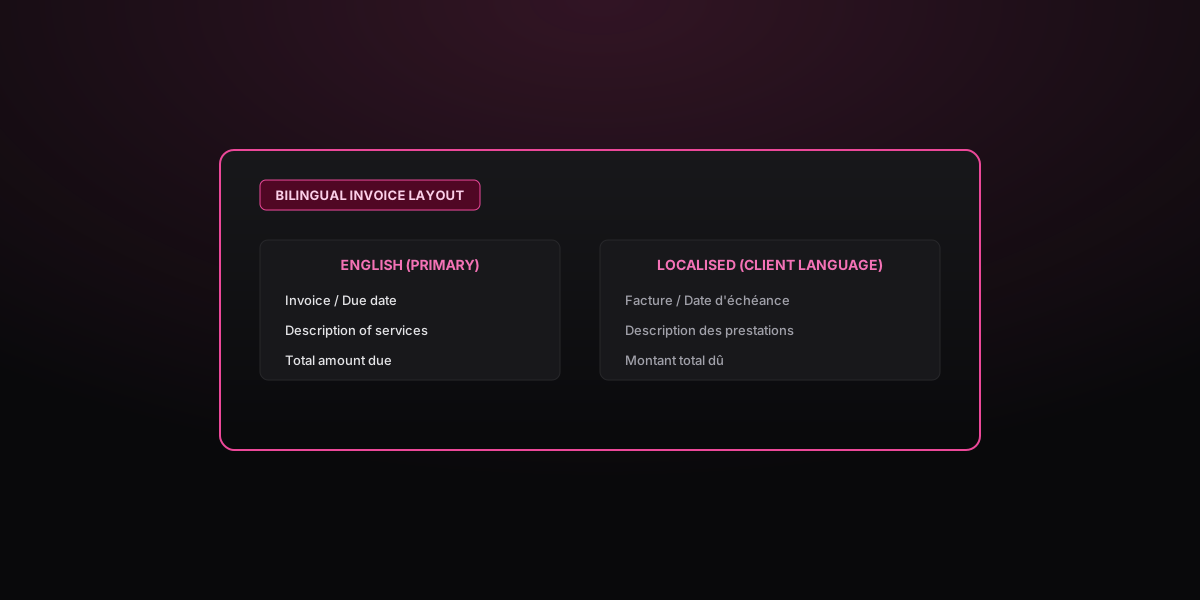
- Paired field labels in both languages, secondary language in lighter grey
- Step
- Dates written as "22 September 2026 / 22 septembre 2026"
- Step
- Amounts with two decimal places and the currency code beside the total
- Step
- Line descriptions in the client's language, matching the purchase order wording exactly, with the studio's own description beneath in smaller text
- Step
- Invoice number, PO number, tax ID and bank details untouched
- Step
- Payment terms stated in both languages, with the due date as a calendar date
Original diagram
Invoicing in another language: bilingual and localised invoices workflow
- 1When translation actually matters
- 2One document, not two
- 3The conventions that cause real confusion
- 4What to keep untranslated
When translation actually matters
Not every international invoice needs translating. The considerations:
A reasonable default: keep field labels bilingual, keep line descriptions matched to whatever the client approved, and translate fully where you bill a market regularly.
- Legal requirement. Some countries require invoices to be issued or made available in an official local language, particularly for domestic transactions or public sector buyers. This has a local answer — check it for the country you invoice into.
- Who processes it. A small client where your contact also pays the bills needs less than a large organisation where the invoice passes through a shared service centre.
- Volume. One invoice a year rarely justifies a bilingual template. Monthly billing into one market does.
- Automation. If the client's system extracts fields automatically, local-language labels are read more reliably.
One document, not two
Issuing separate language versions seems tidier and causes more problems. Two files can diverge — a correction applied to one and not the other — and if a discrepancy is ever noticed, nobody can say which version is authoritative.
A single bilingual invoice avoids this entirely. The usual approach is paired labels:
Set the secondary language slightly smaller or in a lighter weight so the document does not look twice as dense. If the layout becomes crowded, translate only the labels that drive processing — dates, totals, tax and payment terms — and leave the rest in one language.
- Invoice / Facture
- Invoice number / Numéro de facture
- Issue date / Date d'émission
- Due date / Date d'échéance
- Subtotal / Sous-total
- Tax / Taxe
- Total due / Total à payer
The conventions that cause real confusion
Language is usually less of a problem than formatting. Four things cause genuine errors:
Dates:
A date written as 09/07/2026 means 9 July to some readers and 7 September to others. On a due date, that is a direct cause of late payment. Write the month as a word, or use an unambiguous year-month-day form. This is the highest-value single change on any international invoice.
Decimal and thousands separators:
A period and a comma swap roles between countries, so 1.500 can be read as one thousand five hundred or as one and a half. Reduce the risk by using clear spacing, always showing two decimal places, and stating the currency code explicitly next to the total.
Name order and legal identity:
Family name and given name order differs between cultures, and legal entity suffixes carry specific meanings. Use the client's registered name exactly as they provide it, in their order, rather than reformatting it to look familiar to you.
Address format:
Postal code position, line order and the placement of the country all vary. Reproduce the address in the local format rather than forcing it into the shape you use at home.
What to keep untranslated
Some elements should stay exactly as issued, regardless of the document's language:
- Invoice numbers and references — never localise digits or separators
- Purchase order numbers — character for character
- Tax identification numbers — in their official format
- Bank details, including account names as registered
- Registered company names, which are legal identities rather than words
- Currency codes — the three-letter code is universal and unambiguous
Building a reusable template
The efficient approach is to separate the parts that change from the parts that do not.
Because labels rarely change, this is a one-off cost that pays back across every invoice you send into that market.
- List your field labels — there are usually fewer than twenty.
- Have them translated once by a native speaker, ideally someone who has seen local invoices. Machine translation is reasonable for formulaic labels and risky for tax and payment terminology.
- Keep translations in a single table rather than scattered through templates, so adding a language later is a small job.
- Localise the formatting rules alongside the words: date format, separators, currency position.
- Check tax wording separately. Tax terms are not straightforwardly translatable and often have a prescribed local form.
A note on tone
Expectations around directness in payment communication differ between business cultures. What reads as efficient in one market can read as brusque in another, and what reads as polite in one can read as unclear in another. If you bill regularly into an unfamiliar market, it is worth asking someone who works there to read your standard covering email once. The invoice itself should stay factual everywhere.
Common questions
Helpful clarifications
Do I have to issue invoices in my client's language?
Often not as a legal matter, but some countries do require invoices to be issued or available in an official local language, particularly for domestic transactions or public sector clients. Commercially, an invoice a client's finance team can read gets processed faster regardless of the law. Check the requirement for the country you are invoicing into rather than assuming English is always acceptable.
Should I send a bilingual invoice or two separate versions?
One bilingual document is usually better. Two versions create the risk that they diverge, and if a discrepancy is ever found nobody can say which one governs. A single invoice with paired labels — each field shown in both languages — keeps one authoritative document while remaining readable to everyone who needs it.
Should I translate line item descriptions?
Translate the structural labels — invoice, date, due date, subtotal, tax, total — because those drive processing. Line descriptions are more finely balanced: translating helps the approver understand what they are paying for, but the wording should still match whatever the quote or purchase order said. If the PO is in one language, mirror that wording and add the translation alongside rather than replacing it.
Which date format should I use on an international invoice?
Write the month as a word, or use the unambiguous year-month-day form. Numeric formats are read differently in different countries, so a date written as 09/07/2026 genuinely means two different days depending on who opens it. On a due date, that ambiguity translates directly into late payment, which makes this one of the highest-value formatting choices on the document.
Can I use machine translation for invoices?
It is reasonable for standard field labels, which are formulaic and easy to verify. It is riskier for tax terminology, legal wording and payment terms, where a near-miss changes the meaning. A practical approach is to have a native speaker check your template once, then reuse it — the labels rarely change, so the cost is one-off.