Document Standards · 8 min read
E-invoicing explained: structured formats, PDFs and compliance
Emailing a PDF is not electronic invoicing. Understanding the difference matters as more clients and more tax authorities move to structured invoice data.
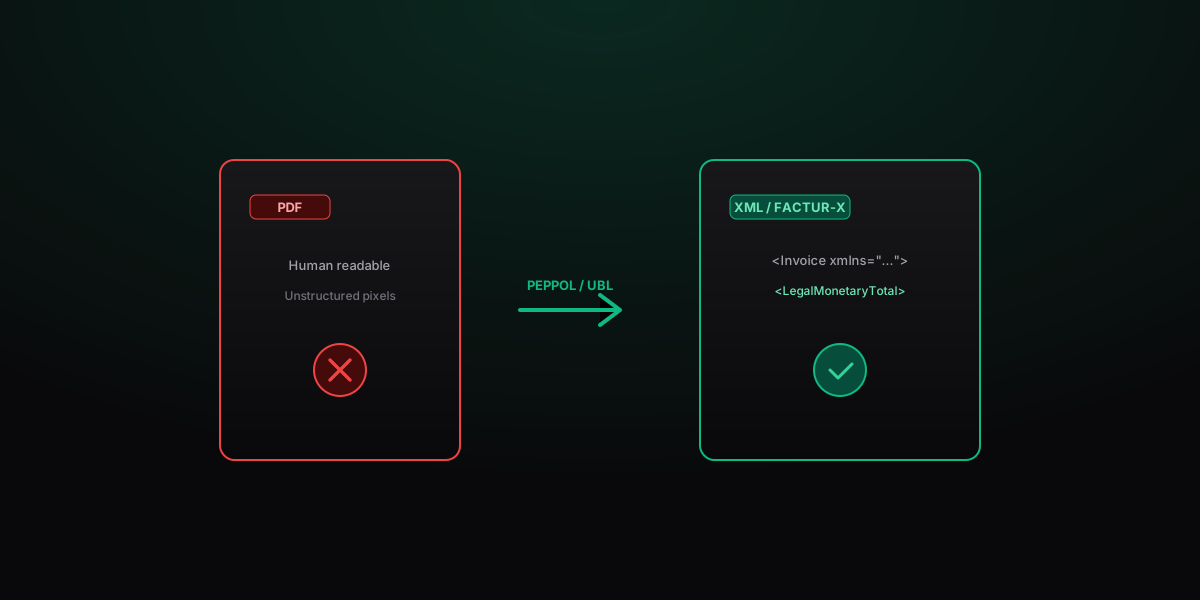
Most small businesses already invoice electronically in the everyday sense: they create a PDF and send it by email. When a client or a government says "e-invoicing," they usually mean something quite different, and the gap between the two is where confusion and last-minute panic tend to happen.
Practical application
E-invoicing explained: structured formats, PDFs and compliance in practice
Emailing a PDF is not electronic invoicing. Understanding the difference matters as more clients and more tax authorities move to structured invoice data.
- Requirement
- Clear compliance and documentation
- Action item
- Follow standard accounting rules and verify with client
Original diagram
E-invoicing explained: structured formats, PDFs and compliance decision flow
- 1The core distinction: readable vs. structured
- 2The formats you will hear named
- 3Clearance vs. post-audit: two regulatory models
- 4What changes in practice
The core distinction: readable vs. structured
A PDF invoice is designed for a human. The layout carries the meaning — you know 1,240.00 is the total because of where it sits on the page and the word above it. A machine reading that PDF has to infer the same thing, which is why automated capture tools get it wrong often enough to need a human reviewing exceptions.
A structured e-invoice removes the guesswork. The same invoice is expressed as tagged data: a field explicitly labelled as the total, another as the tax amount, another as the supplier's registration number. The receiving system reads it exactly, every time, with no layout interpretation at all.
Three categories are worth keeping straight:
- Paper or scanned image. No machine-readable content at all. Requires OCR or manual entry.
- PDF sent by email. Electronic delivery of a human-readable document. Convenient, universally accepted by small clients, but not structured data.
- Structured e-invoice. Machine-readable data, usually XML, exchanged through a network or portal. This is what regulations mean by e-invoicing.
The formats you will hear named
UBL and CII:
Two widely used XML syntaxes for business documents. Most national and network-level invoice specifications are built on one of these rather than inventing something new.
The European standard for electronic invoicing:
A common semantic model defining what an invoice must contain — supplier, buyer, line items, tax breakdown, payment details — so that different countries can implement compatible versions rather than entirely separate systems.
Peppol:
Less a format than a delivery network with agreed document specifications on top. You connect once via an access point provider and can then exchange documents with any other participant. It is a common backbone for public-sector procurement and several national systems.
Factur-X and ZUGFeRD:
Hybrid formats. A single PDF file that a person can open normally, with structured XML embedded inside for machines. Practical when your client base is mixed.
Country-specific systems:
Several countries operate their own platforms, some requiring invoices to be cleared or reported to a tax authority before or shortly after issue. Names, thresholds and deadlines vary and change, which is why they are not listed here — check the current position for your country.
Clearance vs. post-audit: two regulatory models
Broadly, tax administrations take one of two approaches.
The direction of travel in many jurisdictions has been from the first towards the second, but timelines shift and scope varies by business size and transaction type. Treat any specific date you read anywhere — including here — as something to verify.
- Post-audit. You issue invoices yourself and keep records. The authority may examine them later. This is the traditional model in many countries.
- Clearance or continuous reporting. Invoice data is submitted to, or passed through, a government platform at or near the moment of issue. The invoice may not be valid until it has been processed.
What changes in practice
If you move to structured invoicing, several habits have to tighten:
- Client data must be exact. Registered names, addresses, tax identifiers and network IDs are validated. Approximate is rejected.
- Codes replace free text. Units of measure, tax categories and payment means often have to use prescribed code lists rather than your own wording.
- Mandatory fields become genuinely mandatory. An omission that a human client would have ignored will fail validation.
- Corrections follow a defined path. Structured credit notes referencing the original invoice, not an edited resend.
- Archiving requirements may apply to the structured file, not only the readable version.
What this means if you invoice small clients
For a freelancer billing local businesses and consumers, a well-structured PDF with complete, accurate fields is likely to remain workable for some time — and it is also the best possible preparation. Every field you are already recording properly is a field you will not have to reconstruct later.
The mistake to avoid is assuming that because e-invoicing sounds like enterprise infrastructure, it will never reach you. The practical first step is not buying software; it is making sure the data on your invoices is accurate and consistent enough to be machine-readable if it ever needs to be.
Common questions
Helpful clarifications
Is a PDF invoice an e-invoice?
Usually not, in the regulatory sense. A PDF is a picture of an invoice designed for a human to read. An e-invoice is structured data designed for a machine to read, typically XML, so the receiving system can extract every field without guessing. Emailing a PDF is electronic delivery, not electronic invoicing. Some hybrid formats embed structured data inside a PDF and do qualify.
What is Peppol?
Peppol is a network and set of specifications that lets businesses exchange structured invoices and other procurement documents across borders without building a direct connection to each trading partner. You connect once through an access point provider, and that connection reaches everyone else on the network. It is widely used in public sector procurement and in several national e-invoicing systems.
Do I need e-invoicing as a freelancer or small business?
It depends entirely on where you and your clients are based and who you sell to. Public sector buyers in many countries already require it, and a growing number of tax authorities are extending requirements to business-to-business transactions. Requirements and dates change often, so check the current position for your country and sector rather than relying on a general guide.
What is a hybrid invoice format?
A hybrid format packages both versions in one file: a normal PDF that a person can open and read, with structured XML data embedded inside it that a machine can extract. Factur-X and ZUGFeRD are well-known examples. They are popular because a single file works for a large client with automated processing and a small client who just wants to look at it.
Can I keep sending PDF invoices?
For many businesses and many clients, yes, and a well-made PDF remains the most practical format for a large share of invoicing. The point to watch is whether a specific client or a specific jurisdiction requires structured invoicing for your transactions. That is a question with a local answer, so confirm it for your situation before assuming either way.