
Accounting & Tax · 7 min read
Withholding tax on invoices: when a client pays you less
A payment arrives short by a clean percentage. Nothing is wrong with the invoice and the client has not disputed anything — they were legally required to deduct tax before paying you.
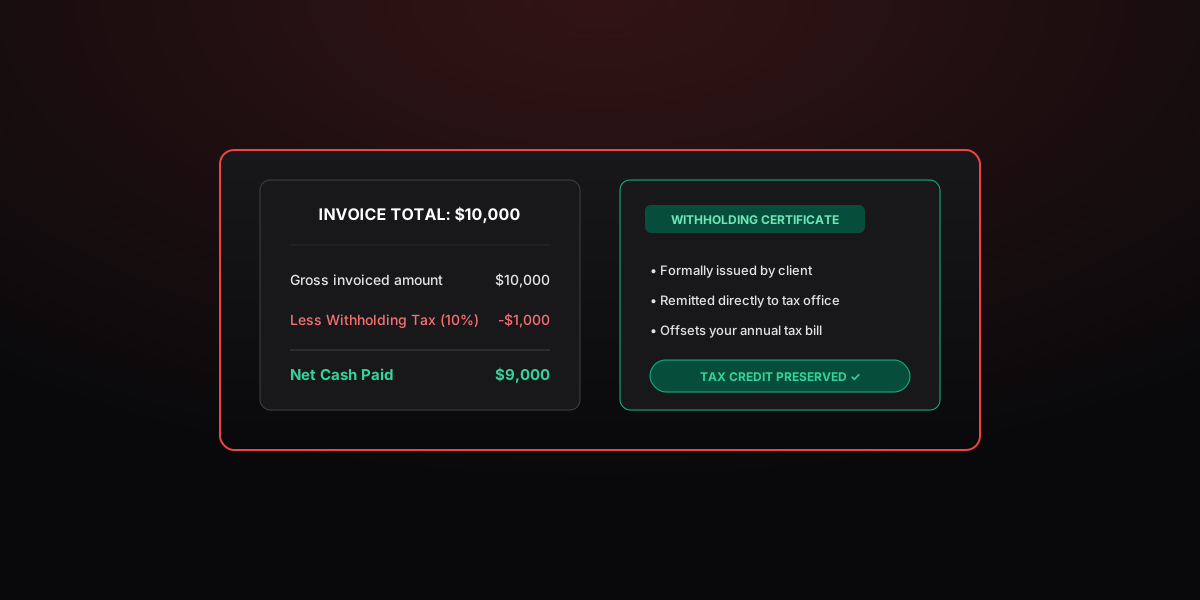
Withholding tax catches suppliers out constantly, particularly the first time they invoice a larger organisation or a client in another country. The instinct is to chase the shortfall as an underpayment. That is usually the wrong response, and it can lead to an awkward conversation where the client explains a legal obligation you should have known about.
Worked example
Worked example
A consultant invoices a corporate client 100,000 for a project. The payment arrives as 90,000.
- Step
- Records the invoice as settled in full at 100,000, with 90,000 received in cash and 10,000 as tax paid on their behalf.
- Step
- Requests the withholding certificate immediately, referencing the invoice number and payment date.
- Step
- Files the certificate with the invoice when it arrives.
- Step
- Adds a note to the client record so future invoices show the expected deduction on the face of the document.
Original diagram
Withholding tax on invoices: when a client pays you less workflow
- 1What withholding tax is
- 2When it typically applies
- 3Showing it on the invoice
- 4Getting the certificate
What withholding tax is
In many countries, a business making certain kinds of payment to a supplier must deduct a portion and remit it directly to the tax authority on that supplier's behalf. The supplier receives the net amount and gets credit for the tax already paid when they file their own return.
The mechanism exists because collecting tax at the point of payment is more reliable than collecting it later from many small suppliers. From your side, three things follow:
Rates, thresholds, which payments are covered, and what the certificate is called all vary substantially by country. This guide deliberately gives none of those numbers, because a figure that is right in one market is misleading everywhere else. Find the position for your country and for any country you invoice into.
- The money is not lost. It has been paid against your tax account, not kept by the client.
- You still earned the gross amount. Your revenue is the invoice total, not the net receipt.
- You need evidence to claim it. Without a certificate or statement, you have a cash-flow cost you cannot offset.
When it typically applies
Common situations, subject entirely to local rules:
The pattern most suppliers notice is that small clients rarely withhold and larger ones often do, because the obligation usually sits on the payer and larger organisations have the systems to comply with it.
- Professional and technical services billed to businesses, particularly above a threshold
- Cross-border payments for services, where the payer's country taxes income arising there
- Royalties and licensing income
- Contract and construction work, which is often subject to its own scheme
- Rent, commissions and certain other recurring payments
Showing it on the invoice
If you know a deduction is coming, put it on the document. It prevents the payment looking like a dispute and makes reconciliation straightforward.
A workable structure:
Two points that matter for your records. First, the receivable in your books is the gross invoice total, not the net; the deduction is tax paid on your behalf, not a reduction in price. Second, withholding generally applies to the fee rather than to sales tax charged on top of it, but the interaction between the two differs by country and is worth confirming once.
If you are unsure whether a client will withhold, invoice the gross amount normally and add a short note asking them to confirm whether any deduction applies. That single sentence avoids the shortfall arriving unexplained.
- Fees — the work, described normally — 100,000
- Sales tax / VAT, if applicable — shown as usual on the gross fee
- Invoice total — the full amount due
- Less tax deducted at source — the expected deduction, labelled explicitly
- Net amount payable — what you expect to receive
Getting the certificate
This is the part that costs suppliers real money, because a deduction without evidence is simply a loss.
- Ask at the point of deduction, not at year end. The contact who processed the payment knows what was deducted; the person who replaces them in March will not.
- Find out the issuing cycle. Some certificates are issued per payment, others periodically. Diarise accordingly.
- Check the details when it arrives — your name, your tax reference, the amount, the period. Errors are common and much easier to correct immediately.
- File it with the invoice, not in a separate place. The invoice, the remittance advice and the certificate belong together.
- Track expected certificates in the same ledger you use for unpaid invoices. A missing certificate is an outstanding item in exactly the same way an unpaid invoice is.
Cross-border withholding
Invoicing into a country that withholds on service payments to foreign suppliers can produce a significant deduction. Two things are worth knowing:
If you invoice regularly into one foreign market, this is a case where a single conversation with an accountant familiar with both countries pays for itself quickly.
- Tax treaties may reduce or remove the deduction, but usually only if the paperwork is filed before payment. Retrospective claims are often possible in principle and difficult in practice.
- Relief in your home country for foreign tax paid depends on your local rules and the treaty position, and requires documentation.
Planning for it
Where withholding applies to a meaningful share of your income, it is a cash-flow issue rather than a cost. You receive less during the year and recover it at filing. Factor that into forecasting, ask new clients at onboarding whether they withhold, and keep certificate collection on the same routine as your receivables review.
Common questions
Helpful clarifications
Why did my client pay less than the invoice total?
If the shortfall is a clean percentage of the fee, the most likely explanation is withholding tax. In many countries a business paying certain kinds of supplier is legally required to deduct tax at source and pay it to the tax authority on the supplier's behalf. The money is not lost — it has been paid against your tax account — but you need a certificate or statement from the client to claim it.
Should I show withholding tax on the invoice?
Where you know it will be deducted, showing it makes reconciliation much easier for both sides. Invoice the full gross amount, then show the expected deduction as a clearly labelled line and state the net amount you expect to receive. The receivable in your books remains the gross figure, with the deduction treated as tax paid on your behalf rather than as a discount.
What certificate should I ask the client for?
Whatever document your tax authority accepts as evidence that tax was deducted and remitted on your behalf. The name and format differ by country, and so does the timing — some are issued per payment, others quarterly or annually. Ask for it at the point of deduction rather than at year end, because chasing certificates months later from a client contact who has moved on is genuinely difficult.
Can I avoid withholding tax on cross-border invoices?
Sometimes the rate is reduced or eliminated under a tax treaty between the two countries, but this almost always requires paperwork submitted before payment, such as a certificate of residence. It is not automatic and cannot usually be applied retrospectively. If you invoice regularly into a country that withholds, it is worth getting specific advice once, since the saving can be substantial.
Can I gross up my price to cover the deduction?
You can price with the deduction in mind, and some suppliers do, but be transparent about it rather than inflating a rate quietly. Note also that a gross-up may itself be subject to withholding, so the arithmetic is rarely as simple as adding the percentage back. Where withholding applies to a meaningful share of your income, treat it as a pricing question to discuss with an accountant.