
Getting paid · 7 min read
Early payment discounts and late fees: pricing your terms
A discount for paying early and a fee for paying late are the two levers you can set before an invoice goes out. Both are frequently used badly — one is more expensive than it looks, the other is often left unenforced.
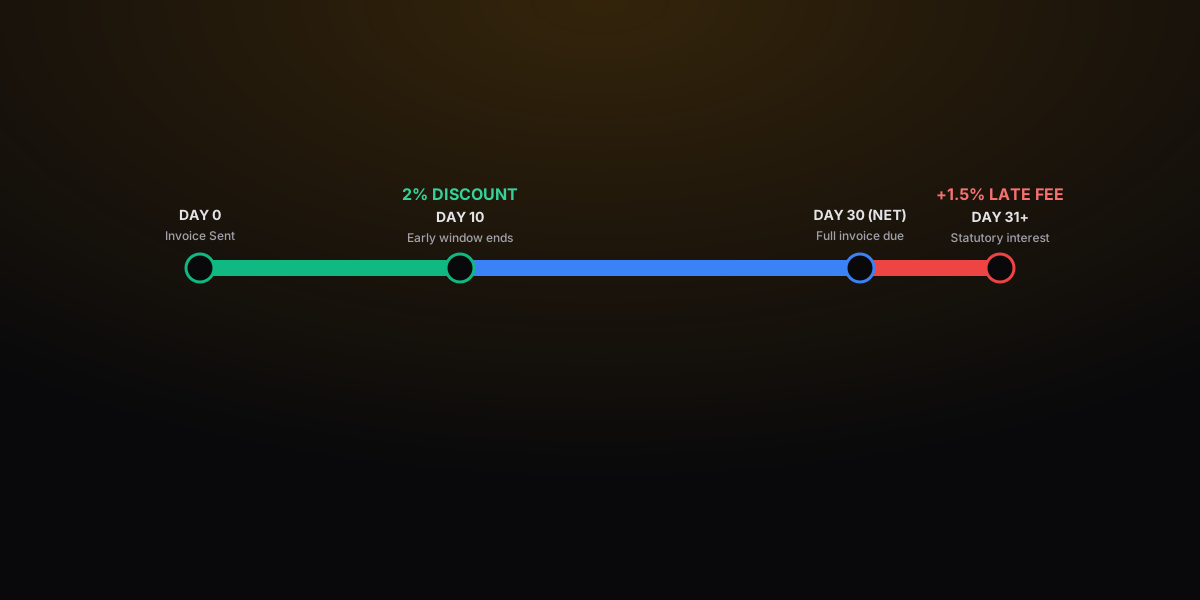
Chasing an overdue invoice is work you do after the fact. Terms are the work you do in advance. Getting them right does not eliminate late payment, but it changes where your invoice sits in a client's queue — which is usually the only variable that actually matters.
Worked example
Worked example: two clients, two approaches
Client A is a small studio that pays within a few days of receiving an invoice. They do not need an incentive. Terms: net 14, late fee clause in the contract, never invoked. Offering them a discount would simply cost money for behaviour you already get.
- Point 1
- Client B is a large manufacturer paying on a monthly run, consistently around day 45 despite net 30 terms. A late fee will not change a scheduled payment cycle. Here the options that work are: negotiating an earlier submission cut-off so the invoice catches the current run, or offering a discount specifically to route the payment outside the normal cycle. Compare the discount cost against the cost of financing the gap and decide on the numbers.
- Point 2
- The lesson is that the same terms serve these two clients badly. Incentives should be matched to why a client is slow, not applied uniformly.
Original diagram
Early payment discounts and late fees: pricing your terms decision flow
- 1Early payment discounts: cheaper cash, at a price
- 2Late fees: signal first, revenue second
- 3What to do before reaching for either lever
Early payment discounts: cheaper cash, at a price
An early payment discount offers the client a reduction for settling before the due date. The classic notation is 2/10 net 30: take 2% off if you pay within 10 days, otherwise pay the full amount within 30.
Work out what it really costs you:
The instinct is to read 2% as small. Look at it as the price of 20 days of money instead. You are paying 2% of the invoice to be paid 20 days earlier. Repeated across a year, that is an effective annual cost in the region of 35–40%, comfortably more than most forms of borrowing.
That framing does not mean discounts are a mistake. It means they should be a decision with a reason behind it:
How to structure one that works:
Watch out for the common corporate habit of taking the discount while paying on the standard timeline. If a client does this, raise it immediately and in writing, or the discount becomes a permanent price cut.
- Good reasons: you would otherwise draw on an expensive credit facility; a specific large client's payment run is unpredictable and the certainty is worth paying for; you need to fund materials before the next job.
- Weak reasons: a competitor offers one; it seems like good customer service; you hope it will improve a chronically late payer's behaviour.
- Make the window short and the saving visible. A discount available for 10 days creates a deadline; one available for 25 days out of 30 does not.
- Show the discounted figure in currency, not just a percentage. "Pay 1,470 by 28 September, or 1,500 by 18 October" is far more effective than "2/10 net 30."
- Define when the clock starts — invoice date or receipt date — and say so.
- State that the discount depends on the payment clearing, not on a transfer being initiated, in the window.
- Apply it consistently. Clients talk, and an inconsistent discount policy is read as an arbitrary one.
- Handle the paperwork properly — if the discount is taken after the invoice is issued, it is normally reflected by a credit note rather than an edit.
Late fees: signal first, revenue second
A late payment fee — a flat charge, an interest rate, or both — has a different job. Its practical function is to communicate that you monitor due dates. That signal alone moves invoices up the queue in businesses that pay the people who notice first.
Getting the legal footing right:
This is the part that varies most by country. Several jurisdictions give suppliers a statutory right to interest and fixed recovery costs on late commercial payments, sometimes regardless of whether the contract mentions it. Others cap what you can charge, treat consumer transactions differently, or require the term to be agreed in advance to be enforceable.
Because of that variation, the useful general rules are:
Writing a clause clients accept:
Keep it factual and unemotional. A clause that reads as a threat invites negotiation; one that reads as administration usually passes without comment. Something like: "Invoices unpaid 14 days after the due date may be subject to a late payment charge of [X] in accordance with applicable law."
Two practical notes. First, a grace period of a week or two before any charge applies avoids penalising a client whose bank simply took an extra day. Second, decide your waiver policy in advance — waiving on a first occurrence, while stating clearly in writing that a charge was due and has been waived as a one-off, preserves the signal without creating friction.
- Agree the term before the work starts, in your quote or contract, not for the first time on the invoice.
- State it plainly on both the agreement and the invoice, with the rate and the trigger.
- Check the local position on maximum rates, statutory entitlements and consumer rules before you set a number.
What to do before reaching for either lever
Discounts and late fees are adjustments at the margin. They work best on top of a billing process that is already prompt and accurate, and they cannot compensate for one that is not.
- Invoice immediately. The most common cause of slow payment is slow invoicing.
- Shorten the default term. Free, and often enough on its own.
- Get the invoice to the right recipient with the right reference, so it never enters an exception queue.
- Ask about payment run dates and time your submission accordingly.
- Take a deposit on new engagements rather than discounting the balance later.
Common questions
Helpful clarifications
What does 2/10 net 30 mean?
It means the client may deduct 2% if they pay within 10 days, and the full amount is otherwise due within 30 days. The notation is common in wholesale and manufacturing. If you use it, write the plain-language version alongside it, because many small clients will not recognise the shorthand and may simply ignore it.
Is a 2% early payment discount expensive?
More than it looks. Giving up 2% to be paid 20 days sooner works out to a very high effective annual rate, far above most borrowing costs. That does not make it wrong, but it means the discount should be justified by something specific, such as avoiding a credit line or reliably converting a slow payer, rather than offered by default.
Can I charge interest on overdue invoices?
In many jurisdictions yes, and in some there is a statutory right to interest and recovery costs on late commercial payments even without a contract clause. Rates, caps and eligibility differ significantly between countries, and consumer transactions are often treated differently from business ones. Check the rules where you operate before stating a rate on your invoice.
Do late fees actually get invoices paid faster?
Their main value is usually as a stated expectation rather than as revenue. A visible late fee clause signals that you track payment dates, which tends to move you up a client's priority list. Actually charging it is a judgement call each time, and many suppliers waive it on a first occurrence while making clear that it was waived.
Should I offer a discount or shorten my payment terms instead?
Try shorter terms first, since they cost nothing. Moving from 30 days to 14 days on new engagements often achieves what a discount would, particularly with smaller clients who pay when the invoice arrives rather than on a scheduled run. Save discounts for clients whose payment timing is genuinely driven by a process you cannot change.