
Getting paid · 7 min read
Invoice payment methods and fees: how to let clients pay you
The payment method you put on an invoice affects how fast you get paid, how much of the invoice you keep, and how exposed you are to reversals months later. It deserves more thought than it usually gets.
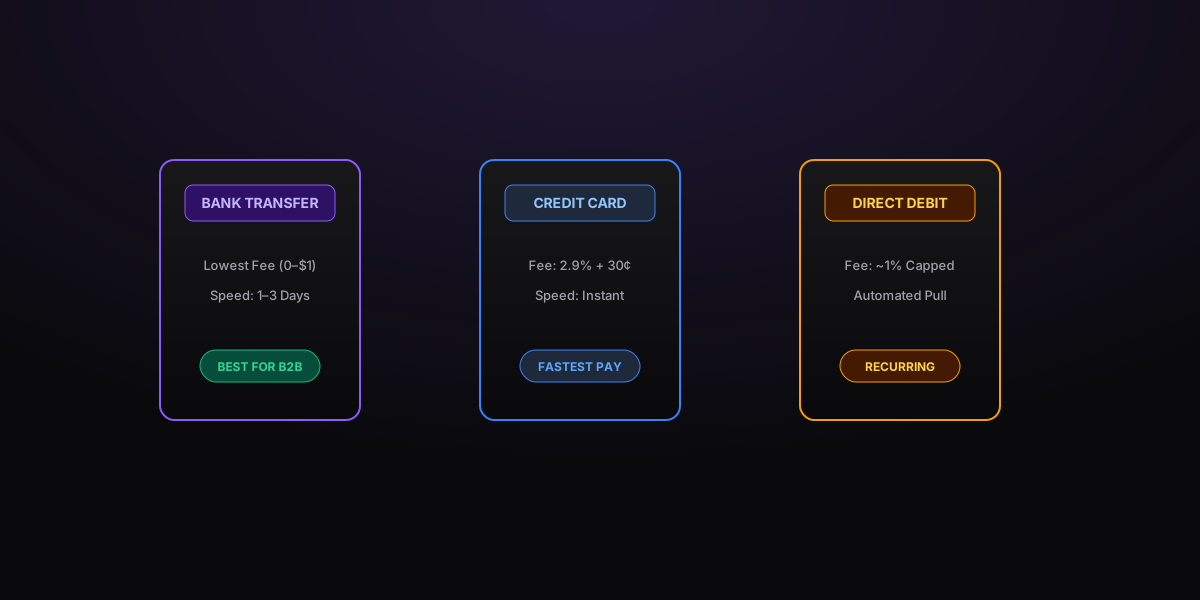
Most people pick a payment method once, early on, and never revisit it. That is fine until the mix of work changes — larger invoices, international clients, recurring retainers — and the method that was convenient at 400 per invoice starts costing real money at 8,000.
Worked example
Worked example: adjusting the mix
A consultant invoices roughly 6,000 per month across a mix of work, accepting card payments for everything because it is simple.
- Step
- Invoices under 1,000: card link as the default. Speed is worth more than the fee.
- Step
- Invoices over 1,000: bank transfer as the default, with card available on request.
- Step
- The two monthly retainers: moved to direct debit, which also removes the chasing.
Original diagram
Invoice payment methods and fees: how to let clients pay you decision flow
- 1Three things to weigh, not one
- 2The main options
- 3Presenting payment details on the invoice
- 4Currency, not just method
Three things to weigh, not one
Cost is the obvious factor and rarely the most important one. Compare methods on three axes:
- Cost — the percentage and fixed fee, plus any currency conversion spread, which is often the larger hidden cost on international payments.
- Speed and friction — how many steps stand between the client deciding to pay and the money arriving. A method that is free but requires the client to log in, re-key your details and get a second approval is not cheap if it adds two weeks.
- Reversal risk — how long the money can be taken back after it lands. Card payments carry chargeback exposure for an extended window; a settled bank transfer generally does not.
The main options
Bank transfer:
Low cost, no percentage, and essentially irreversible once settled. The downsides are friction and reconciliation: the client has to initiate it, and payments arrive without context unless the client uses your reference. Domestic transfer is the default for most B2B invoicing in most markets.
Best for: business clients, larger invoices, anything where the fee percentage would sting.
Card payments:
Fast and frictionless, especially with a payment link on the invoice. You pay a percentage plus a fixed fee, and you carry chargeback risk. For small invoices the convenience usually justifies the cost outright.
Best for: consumers, small invoices, clients who pay from a corporate card, situations where speed matters more than margin.
Direct debit and account-to-account mandates:
The client authorises you to collect on an agreed schedule. Low cost and highly reliable for recurring work, because collection no longer depends on someone remembering. Setup takes longer and requires the client's active consent.
Best for: retainers, subscriptions, any predictable repeat billing.
Instant domestic payment rails:
Many markets now have real-time systems — instant transfer schemes, UPI-style rails, request-to-pay features — that combine near-zero cost with card-like speed. Availability varies enormously by country, so check what is normal where your clients are.
Best for: domestic clients in markets where the rail is widely adopted.
Payment platforms and wallets:
Convenient and familiar, particularly for international or consumer clients. Costs are usually higher than bank transfer, and currency conversion margins can be significant. Some also hold funds or freeze accounts under review, which is a genuine operational risk if it is your only channel.
Best for: international small payments, clients who will not transact any other way.
Cheques and cash:
Still present in some markets and sectors. Slow, manual, and hard to reconcile. Worth accepting only if a client genuinely cannot pay another way.
Presenting payment details on the invoice
How you display the options matters as much as which you offer.
- Lead with one preferred method. Give it full details and visual prominence. List at most one alternative.
- Make the reference impossible to miss. "Please use NS-2026-151 as the payment reference" prevents unmatched payments arriving in your account with no indication of who sent them.
- Include everything needed in one place. Account name, account identifiers, bank name, and for international payments the codes the sending bank will ask for.
- State who pays cross-border charges. International transfers can arrive short if intermediary fees are deducted. Say explicitly that the client covers transfer charges so the full invoice amount arrives.
- Add a payment link if you accept cards. Removing the step of typing details is measurably effective.
- Keep details identical across invoices. Consistency is what makes a fraudulent change stand out.
Currency, not just method
On international invoices, the conversion spread frequently costs more than the transaction fee. Two habits help: state clearly which currency the invoice is payable in, and consider holding an account in your client's currency if you bill the same market regularly. Converting once on your own terms usually beats converting on every payment at someone else's rate.
Common questions
Helpful clarifications
Can I pass card processing fees on to my client?
Sometimes. Surcharging is restricted or prohibited in a number of countries and may also be limited by your card scheme agreement. Where it is permitted, the surcharge usually has to be disclosed before payment and cannot exceed your actual cost. A common alternative is to offer a small discount for bank transfer instead, which achieves a similar result without the same restrictions. Check what applies locally.
What is the cheapest way to get paid?
A domestic bank transfer is usually the cheapest, often free or close to it, because no intermediary is taking a percentage. The trade-off is that the client has to initiate it manually, which can mean slower payment. For recurring work, direct debit typically offers low cost with the reliability of automatic collection.
Should I accept credit cards for large invoices?
Weigh the percentage cost against the speed benefit. On a small invoice a card fee is a rounding error and the convenience often gets you paid the same day. On a large invoice the same percentage can be a meaningful amount, and cards also carry chargeback exposure for months afterwards. Many businesses accept cards below a threshold and bank transfer above it.
How many payment options should I offer?
Two is usually right: one default that suits most clients and one alternative. Listing five options makes the invoice harder to read and does not increase the chance of payment. Present your preferred method first with full details, and mention the alternative in a single line.
Is it safe to put my bank details on an invoice?
Bank account details for receiving payments are routinely shared on invoices and are generally considered low risk on their own. The real risk is impersonation: criminals intercept or spoof invoices and substitute their own account details. Keep your details consistent across invoices, never announce a change by email alone, and tell clients up front to verify any apparent change by phone.