Invoice basics · 6 min read
Invoice vs. receipt: what's the difference and when to use each
They list similar details, but an invoice and a receipt belong to different moments in a transaction — mixing them up creates real bookkeeping problems.
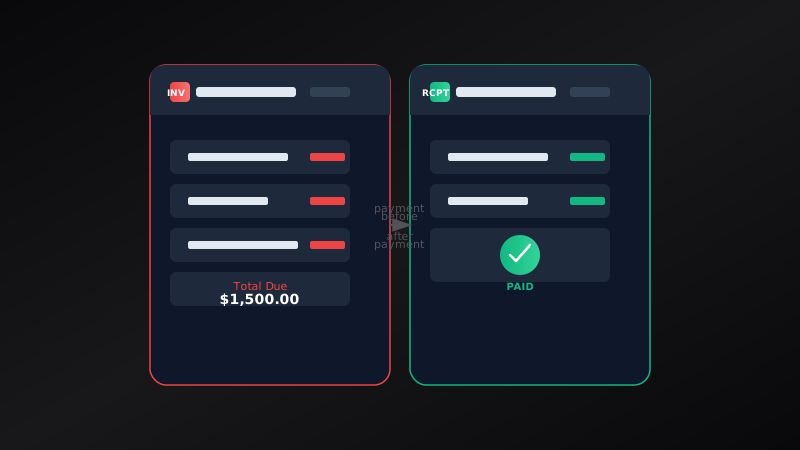
An invoice and a receipt look similar. Both list what was bought, who bought it, and for how much, which is exactly why they get confused. But they serve different moments in a transaction: one asks for money, the other confirms it arrived. Using the wrong one, or treating them as interchangeable, can create confusion for the client and, in some cases, real bookkeeping problems on your end.
Here's the practical difference, and how to use each one correctly.
Side-by-side comparison
Invoice vs. receipt at a glance
An invoice is a request for payment, sent before money changes hands. A receipt is a confirmation of payment, sent after it does.
- Timing
- Invoice: before payment — Receipt: after payment
- Purpose
- Invoice: requests money owed — Receipt: confirms money received
- Triggered by
- Invoice: delivery of goods/services — Receipt: receipt of funds
- Function
- Invoice: a formal demand — Receipt: proof a transaction occurred
- Typical issuer
- Invoice: seller/provider — Receipt: seller or payment processor
Original diagram
Transaction timeline: invoice to receipt
- 1Work delivered or goods shipped
- 2Invoice sent requesting payment
- 3Client pays the amount due
- 4Receipt confirms payment received
Do you need both?
If you invoice clients and they pay by bank transfer or a card link, most accounting software or payment processors generate a payment confirmation automatically once the invoice is marked paid — effectively doubling as your receipt. You may only need to issue a separate receipt if a client specifically asks for one, or if you accept cash or another method that doesn't leave its own paper trail.
In face-to-face retail, there's usually no invoice at all: the transaction and the payment happen at the same moment, so a receipt is the only document needed.
Many invoicing tools let you mark an invoice "Paid" and reissue it as a receipt, which is often enough for small transactions. For accounting purposes, though, it's worth keeping the two records logically distinct — one for what was owed, one for what was collected — even if they share a template.
Common mistakes when mixing them up
A few errors come up repeatedly when the two documents are confused.
- Sending an unpaid invoice labeled "receipt," which can confuse a client about whether payment is still due.
- Using receipt language, like "Thank you for your payment," on a document requesting money that hasn't arrived yet.
- Not issuing any receipt for cash payments, leaving no record for either side.
- Treating a quote or estimate as an invoice — a quote hasn't been billed yet, so it isn't one.
- Losing track of partial payments because the receipt didn't reference the original invoice number.
Why the distinction matters for your books
The invoice/receipt split isn't just wording — it usually maps onto two different accounting events. Depending on the method you use, issuing an invoice can be the point at which revenue is recognized, while the matching receipt is what confirms the cash actually landed.
This is also where the two documents earn their keep during tax season or an audit. An auditor or accountant reconciling your accounts receivable wants to see both sides: what was billed, and what was collected against it.
How to create each one quickly
For an invoice, work from a template that already includes the required fields — business details, invoice number, line items, tax, and total — so you're only filling in the specifics each time. For a receipt, the fastest approach is usually to mark the corresponding invoice as paid and let your tool generate a receipt from it, which keeps the two documents linked and your records easy to reconcile later.
Common questions
Helpful clarifications
Can an invoice also be a receipt?
Not at the same time. An invoice effectively becomes a receipt only once it's marked paid and reissued to confirm payment — until then, it's still a request.
Is a receipt legally required?
In many places, businesses are required to provide a receipt on request, and some jurisdictions require one automatically for certain transaction types. Requirements vary, so check what applies where you operate.
What is a "paid invoice," and is it the same as a receipt?
A paid invoice is an invoice marked as settled. It's close to a receipt in function, but a dedicated receipt is usually clearer proof of payment because it's framed as a confirmation rather than a request.
Do freelancers need to issue receipts?
Not always, especially if clients pay through a system that generates its own payment confirmation. It's good practice to offer one if a client asks, particularly for cash or informal payments.
What details must a receipt include?
At minimum: the amount paid, the date, the payment method, and your business details. Including a reference to the related invoice number makes it easier to match records later.
How long should I keep invoices and receipts?
Most tax authorities expect records to be kept for several years, commonly three to seven, depending on your country. Check your local requirement, since it varies by jurisdiction and business type.