
Getting paid · 7 min read
Deposits and advance payments: how much to ask for and how to invoice it
A deposit is not a percentage you pick because everyone else uses it. It is a number that should correspond to something specific: what you stand to lose if the work stops after you have started.
Most late payment problems are solved at the end, with reminders and escalation. Deposits solve a different problem at the start: they remove the situation where you have delivered everything you owe and the client has delivered nothing.
Worked example
Worked example
A joiner quotes 9,200 for a fitted kitchen: 5,000 in materials, 4,200 in labour across three weeks.
- Point 1
- A flat 50% deposit would be 4,600 — less than the materials bill. Instead the quote states: materials in full (5,000) on acceptance, balance of 4,200 on completion.
- Point 2
- The client can see exactly what the money is for, so the larger figure is easier to accept than a smaller unexplained percentage. The joiner is never out of pocket on materials. Deposit invoice JW-2026-031 is issued on acceptance; final invoice JW-2026-047 shows 9,200, less 5,000 received on 2 September, balance 4,200.
Original diagram
Deposits and advance payments: how much to ask for and how to invoice it workflow
- 1What a deposit is actually for
- 2Setting the amount
- 3Asking without friction
- 4The paperwork
What a deposit is actually for
Three distinct purposes get bundled under one word, and they justify different amounts:
Being clear about which of these applies makes the conversation easier, because you can explain the number rather than defend it.
- Covering committed costs. Materials, subcontractors, software licences, travel. Money you spend before you are paid and cannot recover if the project stops.
- Covering committed capacity. Time you have blocked out and turned other work away for.
- Establishing commitment. A client who has paid something behaves differently from one who has not. Scope creep, slow feedback and silent disappearances all drop noticeably.
Setting the amount
Rather than starting from a percentage, start from your exposure and work back.
Cost-led work:
If you are buying materials or paying subcontractors, the deposit should at minimum cover those committed costs plus a share of your fee. A client who queries this usually accepts it once they see it broken down — "materials 2,400 plus 20% of fee" is far more persuasive than "50%".
Time-led work:
Where your main input is your own time, the exposure is the work you turn down. A deposit of roughly one phase of the project, or the first month of a long engagement, is usually defensible.
Date-reserved work:
For anything where you hold a specific date — events, shoots, installations — the deposit is buying the date. It should reflect what that date is worth, because you cannot resell it late.
Common ranges land between 25% and 50%, but treat those as a sanity check, not a starting point. New clients, long lead times and high cancellation impact all push the figure up. Established clients with a good payment record can reasonably push it down.
Asking without friction
How you introduce a deposit matters more than the amount. A few things consistently help:
- Raise it in the quote, not after acceptance. A deposit that appears for the first time when the client has already said yes feels like a change of terms.
- State it as standard practice. "Projects start on receipt of the deposit" is normal. "Would you be able to pay something upfront?" invites negotiation.
- Tie it to the start date. The deposit is what triggers scheduling, which makes it the client's step rather than a hurdle you have imposed.
- Explain what it covers if the figure is large or the client is new to working this way.
- Make it easy to pay. A deposit invoice with a payment link removes days from the start of the project.
The paperwork
Two documents, in this order:
1. The deposit invoice:
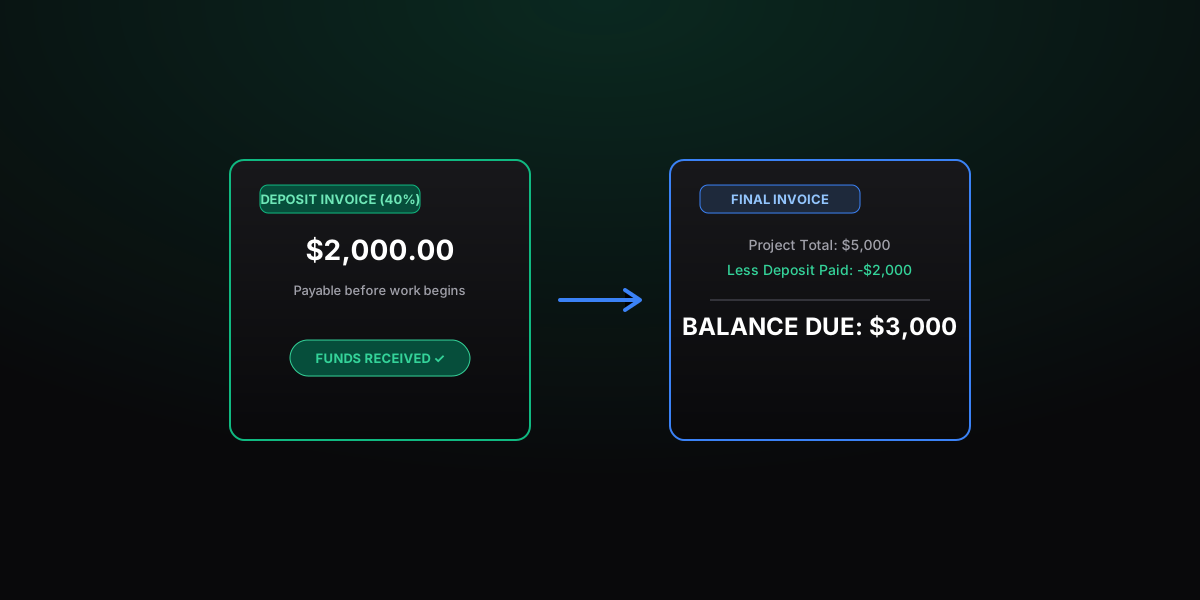
A real invoice, with its own number in your normal sequence, a due date, and a line that describes what it is: "Deposit — 40% of project value, brand identity project." Not "Deposit" alone, which tells a finance team nothing.
If the client's process requires a document before anything is owed, send a proforma instead and follow with the invoice once they commit.
2. The final invoice:
Show the whole picture, not just the balance:
Invoicing only the balance with no explanation is the most common deposit mistake. Your records show 4,800 of revenue across two invoices; the client's show one invoice for 2,880 and a payment they may have filed as something else entirely.
- The full project value as line items
- A deduction line: "Less deposit paid, invoice NS-2026-088, received 12 September"
- The balance due, with its own due date
Refundability and cancellation
Decide the position before you take the money, write it in the quote, and repeat it on the deposit invoice. A workable default is that the deposit is refundable until work begins or costs are committed, and non-refundable after that, since that is the point at which you have genuinely lost something.
Two cautions. Consumer protection rules in many countries restrict what a business can retain from a consumer, and a clause that is unreasonable may not be enforceable regardless of what it says. And if you hold deposits for work far in the future, take advice on how they should be treated in your accounts, because received-but-unearned money is not the same as revenue.
When a deposit is not the right tool
The underlying question is always the same: if this stopped tomorrow, what would I have spent that I cannot get back? Answer that honestly and the right deposit is usually obvious.
- Large organisations with no-advance-payment policies. Not a red flag, just a constraint. Propose a short first milestone instead — delivered in two weeks, invoiced immediately.
- Established clients who pay reliably. Adding a deposit to a good relationship buys little and can read as distrust.
- Very small jobs where the administration costs more than the risk.
Common questions
Helpful clarifications
How much deposit should I ask for?
Set it against what you would actually lose if the client walked away after you started. A common range is 25% to 50%, but the useful anchor is your own exposure: if you buy materials or block out a month of capacity, the deposit should cover that, not a round percentage. For projects with heavy upfront costs, asking for the cost portion in full plus a share of the fee is reasonable and easy to justify.
Should a deposit be refundable?
Decide before you take it and put it in writing. The common position is that a deposit becomes non-refundable once you begin work or commit to costs, because at that point you have genuinely lost something. A deposit taken purely to reserve a date is a different case. Consumer protection rules in some countries limit what can be retained, so check what applies rather than assuming a clause is enforceable.
Do I invoice a deposit or send a proforma?
Either works, and the choice depends on what the client needs. A deposit invoice is a real invoice with a due date, which is right when the deposit is contractually owed. A proforma is right when the client needs a document to get internal approval before anything is owed. If you are unsure, ask the client which their finance process expects.
How do I show the deposit on the final invoice?
Show the full project value, then a clearly labelled deduction line referencing the deposit invoice number and the date it was paid, then the balance due. Never quietly invoice only the balance without explanation, because the client's records will show a total that does not match yours and the difference will surface at year end.
What if a client refuses to pay a deposit?
Find out why before conceding. Some large organisations genuinely cannot pay in advance of delivery as a matter of policy, which is a process constraint rather than a signal about the client. In that case a first short milestone works better than a deposit. If a small client simply does not want to, treat the reluctance as information about how the rest of the payment relationship is likely to go.