
Getting paid · 7 min read
Deposit invoices: how to request and structure upfront payments
Asking for money before you've delivered anything feels awkward until you have a clear format for it. Here's how to structure the request so it reads as standard practice, not a red flag.
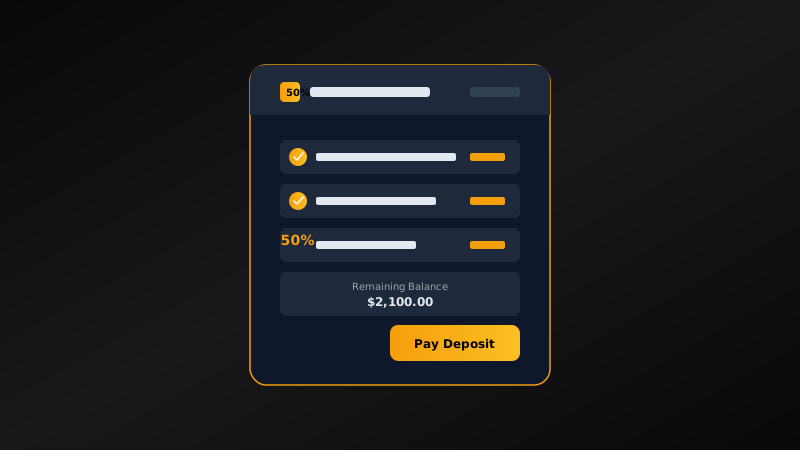
Asking a new client for money before you've delivered anything can feel awkward, but a deposit protects both sides. It gives you working capital to cover materials or blocked-out time, and it gives the client a lower-risk way to commit before the full project fee is on the table. Done clearly, a deposit invoice is no more complicated than a regular one — here's how to structure it.
Worked example
A 50% deposit for a custom furniture project
A furniture maker quotes a client $4,200 for a custom dining table, with 50% due before work starts.
- Title
- Deposit Invoice — 50%
- Invoice #
- WK-2026-009-D
- Bill to
- Client name and address
- Line item
- Deposit for custom dining table project — 50% of $4,200 total — $2,100.00
- Note
- Remaining balance of $2,100.00 due on completion, invoiced separately
- Terms
- Due before project start, bank transfer or card
Original diagram
Deposit invoice lifecycle
- 1Quote accepted by client
- 2Deposit invoice sent (partial amount)
- 3Deposit received — work begins
- 4Final invoice sent (balance due)
When to ask for a deposit
Deposits are standard practice in many industries. They make the most sense when you need to commit resources before delivery.
- The project requires you to buy materials or supplies before starting.
- You're blocking out a significant amount of time exclusively for one client.
- The client is new and you have no payment history with them.
- The total project value is large relative to your regular cash flow.
- Your industry treats deposits as standard practice — events, custom builds, construction, and design work commonly do.
How much should you ask for?
There's no universal rule, but a few patterns come up often: 25–33% for smaller projects with an established client, 50% for new clients or mid-size projects, 50% upfront plus milestones for large multi-phase projects, and 100% upfront for very small jobs or digital products.
Whatever percentage you choose, state it in your quote or contract before you invoice for it, so the number on the deposit invoice isn't the first time the client hears it.
Structuring a deposit invoice correctly
Label the invoice clearly — "Deposit Invoice" or "Invoice — 50% Deposit" in the title — so it isn't mistaken for the full project bill. Give it its own invoice number in your normal sequence; don't reuse the number you plan to use for the final invoice.
Instead of a vague "Deposit" line, name what it's securing: "Deposit — Kitchen cabinetry project (50% of $4,200 total)" tells the client exactly what the payment relates to.
Include a line or note showing the total project fee, the deposit amount, and the balance that will be due later. Deposits are typically due faster than standard invoices — state "Due prior to project start" or a specific date.
Handling refunds and cancellations
Decide your refund policy before you take the first deposit, not after a client asks to cancel.
- State whether the deposit is refundable, partially refundable, or non-refundable in your contract or quote.
- For custom work with material costs, a non-refundable or partially refundable deposit is standard.
- Put the policy in writing somewhere the client agreed to it — an invoice alone isn't a substitute for a contract.
Common questions
Helpful clarifications
Is a deposit invoice legally binding?
An invoice records what's owed, but the enforceable agreement is usually the quote or contract the client agreed to beforehand. It's worth having both — a signed agreement for the terms, and the deposit invoice for the payment record.
What if a client refuses to pay a deposit?
Treat it as a signal to clarify terms before starting, not a reason to push through anyway. Most professionals who require deposits simply don't begin work until it's received, which is easier to hold to if you set the expectation at the quote stage.
Should deposits be taxed?
In many places, yes — a deposit is usually treated as an advance payment for taxable goods or services, so the same tax rules that apply to your regular invoices typically apply here too. Confirm with a local accountant if you're unsure.
Can I use the same invoice number for the deposit and the final invoice?
It's cleaner not to. Give the deposit its own number, and reference it by number on the final invoice, so anyone reviewing your records can trace the full transaction.
What's the difference between a deposit and a retainer?
A deposit is a one-time upfront payment toward a specific project's total cost. A retainer is a recurring payment that reserves your time or availability on an ongoing basis, often billed monthly, whether or not it's fully used.
Do I need a contract in addition to a deposit invoice?
Generally yes, especially for anything beyond a small job. The invoice documents the payment; the contract or quote documents what both sides agreed to, including what happens if the project changes or is cancelled.