
Document Standards · 7 min read
Credit notes and invoice corrections: how to fix a sent invoice
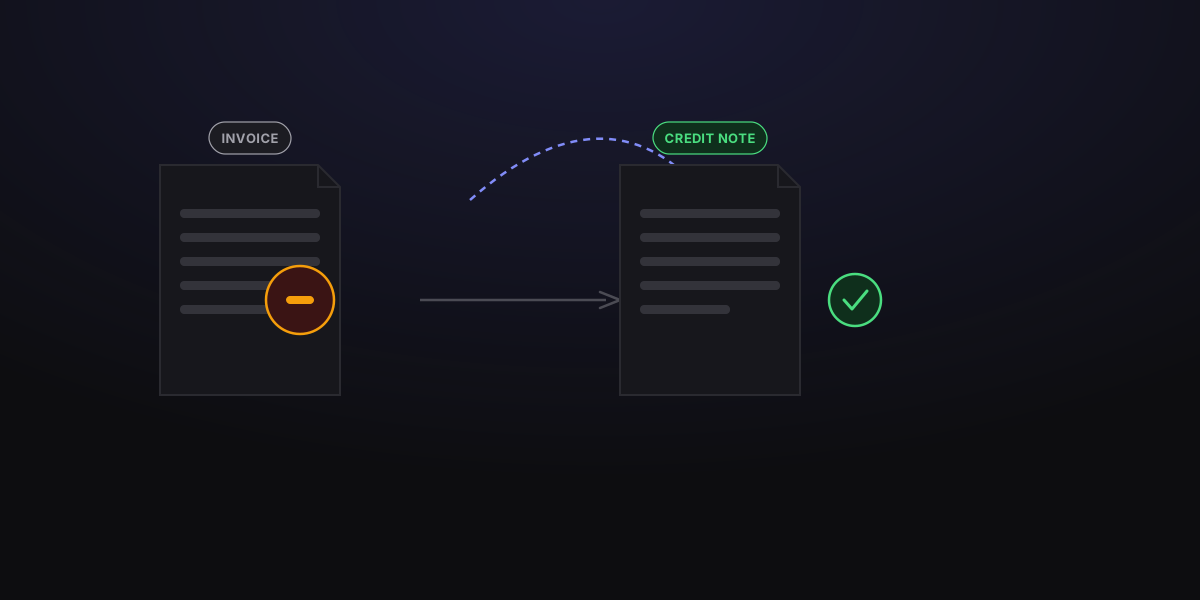
An invoice that has been sent is a record, not a draft. When something is wrong with it, the fix is a second document that references the first — not a quiet edit to the original.
You should not. Once an invoice has left your hands, the client has a copy and may have already entered it into their accounts payable system. Quietly changing the file creates two different documents with the same number, which is exactly what auditors and finance teams look for. Issue a credit note instead, then a corrected invoice if one is needed.
A credit note reduces what the client owes you on paper. A refund moves money back to the client. If the invoice is unpaid, a credit note alone settles the adjustment. If the invoice was already paid, you will usually issue the credit note to correct the record and then send an actual refund, or apply the credit against the client's next invoice if they agree.
Yes. Give credit notes their own sequential series, such as CN-2026-007, kept separate from your invoice numbers. Every credit note should state the number and date of the invoice it relates to. That single reference is what lets you, your client, and an accountant match the two documents years later.
A debit note increases the amount owed rather than reducing it. It is used when an invoice undercharged, for example when an agreed surcharge or extra quantity was left off. Many small businesses simply issue a second invoice for the shortfall instead, which is usually clearer for the client. Whichever you choose, reference the original invoice on the document.
Practically, as soon as you spot the error, because the correction has to land in the right accounting period wherever possible. Formal time limits for adjusting tax on a corrected invoice vary considerably between countries, so check the rules that apply to you before correcting an invoice from a closed period.
Every business gets an invoice wrong eventually. A quantity is off, a discount was agreed after sending, the wrong entity is named, or a client returns part of an order. The instinct is to open the file, correct the number, and resend it. That instinct causes far more trouble than the original mistake.
Worked example
Worked example: a partial return
A supplier invoices a retailer on 3 September, invoice NS-2026-140, for 20 units at 45 each, total 900 before tax. On 9 September the retailer reports that four units arrived damaged and returns them.
- Step
- The supplier issues credit note CN-2026-007 dated 9 September.
- Step
- It references NS-2026-140 and states the reason: "4 units returned, damaged in transit."
- Step
- It lists one line: 4 units at 45, value 180, with tax calculated on the same basis as the original.
- Step
- It closes with a line the client can act on: "Net amount now payable on invoice NS-2026-140: 720 plus tax."
Original diagram
Credit notes and invoice corrections: how to fix a sent invoice decision flow
- 1Why you should never edit a sent invoice
- 2What a credit note does
- 3Choosing the right correction
- 4Track credits as carefully as invoices
Why you should never edit a sent invoice
The moment an invoice leaves your system, you lose control of how many copies exist. Your client's accounts payable software may have already captured it. Their approver may have a PDF in an email thread. If you edit the original and resend it under the same number, three problems follow:
Correcting through a separate document costs you two minutes and removes all three risks.
- Two documents share one number. Nobody can tell which version is authoritative without comparing them line by line.
- Reconciliation breaks. If the client already recorded the first version, their ledger and yours will disagree by the difference, and the discrepancy will surface at the worst possible moment.
- Your audit trail disappears. A clean set of records shows what was charged, what changed, and why. An overwritten file shows only the end state.
What a credit note does
A credit note (also written credit memo) is a document that reduces the amount a client owes. Structurally it is an invoice in reverse: it lists line items, quantities and amounts, but those amounts decrease the balance rather than increase it.
It is used for:
What belongs on a credit note:
- Cancelling an invoice entirely — a full credit note for the same total, issued when an invoice should never have gone out.
- Reducing an invoice partially — a returned item, an unapproved line, a goodwill reduction after a service issue.
- Applying a discount agreed after the fact — for example an early-settlement discount the client qualified for.
- Correcting an overcharge — the wrong rate, a duplicated line, or a quantity error in the client's favour.
- The words "Credit Note" clearly at the top
- Its own reference from a separate series, e.g. CN-2026-007
- The number and date of the original invoice it adjusts
- A short, specific reason — "2 units returned, damaged in transit" beats "adjustment"
- The affected line items, not just a lump sum, where the adjustment is partial
- Tax shown on the same basis as the original invoice
- The date the credit note was issued
- Whether the credit is refunded, offset, or held against future invoices
Choosing the right correction
The invoice is unpaid and entirely wrong:
Issue a full credit note cancelling it, then issue a fresh invoice with a new number and the correct details. Reference the cancelled invoice on the new one so the client can see the relationship. Do not reuse the old number.
The invoice is unpaid and mostly right:
Issue a partial credit note for the difference. The client pays the original invoice minus the credit. Tell them explicitly what to pay, because "invoice 088 less credit note 007" is easier to process than leaving them to work it out.
The invoice was underpriced:
Do not credit and reissue at a higher value without discussing it first. Either issue a debit note or, more commonly for small businesses, a second invoice for the shortfall with a clear explanation. An unexpected increase is a conversation, not a document.
The invoice is already paid:
Issue the credit note to correct the record, then agree with the client whether you refund the difference or carry it forward. Carrying it forward is usually simpler for both sides, but only with written agreement — an unexplained credit balance tends to be forgotten by whichever party benefits from forgetting it.
Only the wording is wrong:
If the error is cosmetic and does not change the amount, the entity, the tax treatment, or the date — a misspelled contact name, for instance — you can often send a corrected copy with a note explaining the change, keeping both versions on file. Anything touching money or legal identity should go through a credit note.
Track credits as carefully as invoices
Outstanding credit balances are easy to lose, particularly when a client stops trading with you before using one up. Include unapplied credits in whatever review you do of open invoices, and tell clients when they have a balance available. It is a small courtesy that costs nothing and reliably improves how clients view your billing.
Common questions
Helpful clarifications
Can I just edit an invoice I have already sent?
You should not. Once an invoice has left your hands, the client has a copy and may have already entered it into their accounts payable system. Quietly changing the file creates two different documents with the same number, which is exactly what auditors and finance teams look for. Issue a credit note instead, then a corrected invoice if one is needed.
What is the difference between a credit note and a refund?
A credit note reduces what the client owes you on paper. A refund moves money back to the client. If the invoice is unpaid, a credit note alone settles the adjustment. If the invoice was already paid, you will usually issue the credit note to correct the record and then send an actual refund, or apply the credit against the client's next invoice if they agree.
Does a credit note need its own number?
Yes. Give credit notes their own sequential series, such as CN-2026-007, kept separate from your invoice numbers. Every credit note should state the number and date of the invoice it relates to. That single reference is what lets you, your client, and an accountant match the two documents years later.
What is a debit note?
A debit note increases the amount owed rather than reducing it. It is used when an invoice undercharged, for example when an agreed surcharge or extra quantity was left off. Many small businesses simply issue a second invoice for the shortfall instead, which is usually clearer for the client. Whichever you choose, reference the original invoice on the document.
How long do I have to issue a credit note?
Practically, as soon as you spot the error, because the correction has to land in the right accounting period wherever possible. Formal time limits for adjusting tax on a corrected invoice vary considerably between countries, so check the rules that apply to you before correcting an invoice from a closed period.